Notice: Undefined variable: imgsize in /home/chindiar/domains/we-teach-reading.com/public_html/wp-content/themes/blogmag/single-narrow.php on line 19

How to Teach Reading to Preschoolers: A Parent’s Guide

Notice: Undefined index: ssba_bar_buttons in /home/chindiar/domains/we-teach-reading.com/public_html/wp-content/plugins/simple-share-buttons-adder/php/class-buttons.php on line 602
Notice: Undefined index: ssba_bar_buttons in /home/chindiar/domains/we-teach-reading.com/public_html/wp-content/plugins/simple-share-buttons-adder/php/class-buttons.php on line 602
Notice: Undefined index: ssba_bar_buttons in /home/chindiar/domains/we-teach-reading.com/public_html/wp-content/plugins/simple-share-buttons-adder/php/class-buttons.php on line 602
Notice: Undefined index: ssba_bar_buttons in /home/chindiar/domains/we-teach-reading.com/public_html/wp-content/plugins/simple-share-buttons-adder/php/class-buttons.php on line 602


Table of Contents
The Problem No One Warns You About
Australian children are falling behind on reading, and the gap opens before they ever set foot in a classroom.
One in three Australian students is not meeting minimum literacy standards, according to 2024 NAPLAN results. That’s approximately 450,000 children nationally. If your child is between three and seven right now, this window is the one that matters most.
This guide gives you the exact, evidence-based sequence to teach reading at home, no teaching degree required.
Is Your Child Ready to Read? 7 Signs to Look For
Starting too early frustrates children. Starting too late means missing ground. Reading readiness is not a fixed age; it’s a cluster of skills.
Watch for these seven markers:
1. Pretend reading
Your child picks up a book and narrates a story from the pictures. This shows they understand that books carry meaning.
2. Print awareness
They point to words on a cereal box or street sign and ask, “What does that say?” They understand that marks on a page represent language.
3. Book handling
They hold books the right way up, turn pages front to back, and understand that English text runs left to right.
4. Rhyme recognition
They notice that “cat” and “hat” sound similar. This is the first signal that phonological awareness, the ability to hear and manipulate sounds in words, is developing.
5. Letter curiosity
They ask about letters, want to write their name, or recognise letters in the environment.
6. Sustained attention
They can sit through a full picture book without losing interest. Reading instruction requires focused listening in short bursts.
7. Vocabulary range
They use sentences of five or more words with varied vocabulary. Comprehension depends on knowing what words mean. You can’t understand what you decode if you don’t know the word.
Most children show these signs between the ages of four and five. Some are ready at three. A child who isn’t showing most of these signs at five warrants a conversation with their preschool teacher or a speech pathologist.

The Science of Reading: Why Most Advice You’ve Heard Is Wrong
For decades, Australian classrooms used “balanced literacy“, a method that mixes phonics instruction with whole-language strategies like guessing words from picture cues or context. Research now shows this approach leaves a significant proportion of children unable to decode text reliably.
The Science of Reading is not a program. It’s the accumulated body of cognitive science research on how the brain learns to read. The central finding, replicated consistently since the US National Reading Panel’s landmark 2000 report, is this:
Systematic, explicit phonics instruction is the most effective method for teaching most children to read — and the only reliably effective method for children at risk of reading difficulties.
The Simple View of Reading, developed by Gough and Tunmer in 1986, describes reading comprehension as the product of two skills: decoding (sounding out words) multiplied by language comprehension (understanding spoken language). Zero in either factor means zero reading ability. Both must be taught.
In Australia, this has resulted in a policy shift. Several states, including NSW, Victoria, and South Australia, have moved toward structured literacy approaches in their school curricula. If you want your child ahead of that curve before they enter a classroom, start with phonics explicitly and systematically.
When I worked through this framework with my own four-year-old, the shift from guessing words to actually decoding them was visible within weeks. She went from memorising five sight words to sounding out words she had never seen before. That is the difference between memorisation and reading.
The Three Teaching Methods Compared
| Approach | How It Works | Evidence Level | Verdict for Home Use |
| Whole Language | Children learn to read through exposure to meaningful texts; word recognition via context and picture cues | Weak. Research consistently shows higher failure rates, especially for at-risk learners | Not recommended as a standalone method |
| Balanced Literacy | Mix of phonics mini-lessons with whole-language reading strategies (MSV cueing — meaning, structure, visual) | Mixed. Phonics component helps; MSV cueing actively interferes with decoding development | Not recommended. Cueing systems undermine phonics |
| Structured Literacy (Systematic Phonics) | Explicit, sequential teaching of sound-letter relationships; phonemic awareness → phonics → fluency | Strong. Supported by NRP 2000, Macquarie University’s MiniLit/MultiLit research, and international replication | Recommended. Most transferable to home teaching |
The structured literacy approach is what this guide teaches. It is the method with the strongest evidence base and the clearest sequence for a parent working without specialist training.
Stage 1: Phonological Awareness (Ages 3–4)
Phonological awareness is the ability to hear and manipulate the sound structure of language syllables, rhymes, and individual sounds. It is the foundation on which everything else is built. You do not need any books or formal lessons for this stage. It is entirely oral.
What to Teach
Syllable clapping
Clap out the syllables in words together. “El-e-phant” is three claps. “Dog” is one. Five minutes of this at dinner consistently builds the skill faster than any workbook.
Rhyme production
Start with rhyme recognition (“Do cat and hat rhyme?”), Then move to production (“what rhymes with dog?”). Nonsense words count — “frog, dog, log, brog” is fine.
Onset-rime manipulation
Split words into their beginning sound (onset) and the rest (rime). “C – at.” “D – og.” “B – us.” This directly primes the brain for phonics.
Alliteration
“Peter Piper picked a peck.” Reading books with alliteration, playing “I Spy with words that start with the /b/ sound,” and tongue twisters all develop sensitivity to initial sounds.
What You Are Building Toward
By the end of this stage, your child should be able to:
- Clap syllables in 2–3 syllable words
- Recognise and produce rhymes
- Identify the first sound in simple words (“What sound does ‘sun’ start with?”)

Stage 2: Phonics and Decoding (Ages 4–6)
Phonics is the taught relationship between sounds (phonemes) and written letters or letter combinations (graphemes). This is where reading formally begins.
The Phoneme-Grapheme Sequence (What to Teach, In Order)
Do not jump to alphabet books that go A to Z. That is not a teaching sequence; it is an organisational convenience. Teach phonemes by frequency and decodability instead.
Step 1: Introduce the first 6 high-frequency phonemes
s, a, t, p, i, n
With just these six sounds, a child can blend and read dozens of real words: sit, tin, nip, pan, spit, naps. Start with consonant-vowel-consonant (CVC) words only.
Step 2: Blending practice
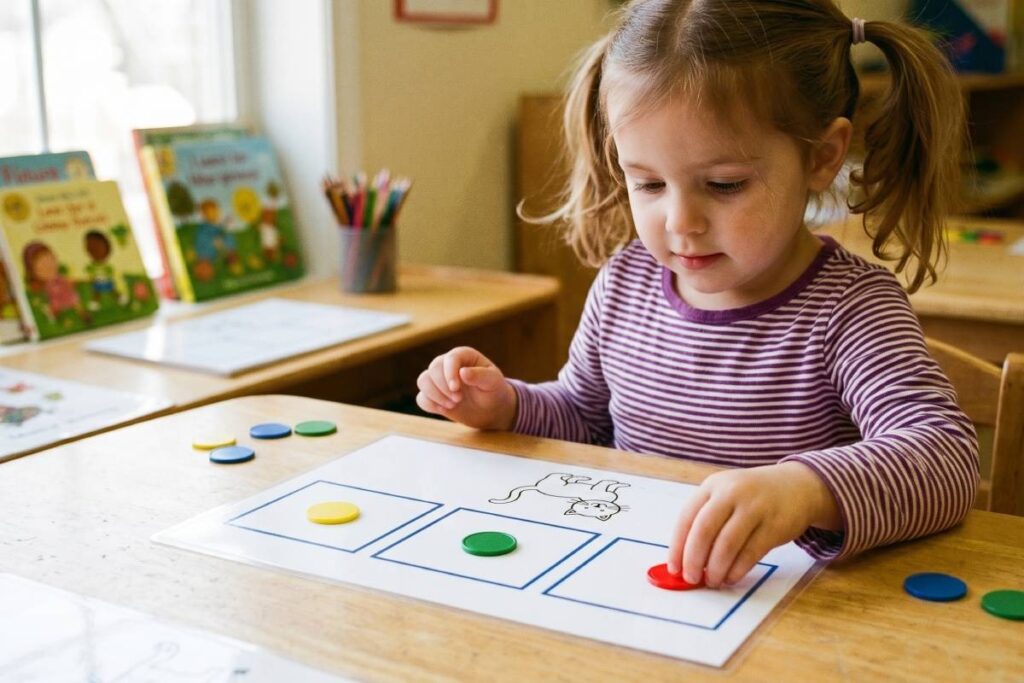
Hold up letter cards one at a time and have your child push sounds together. “c… a… t — cat.” Use Elkonin boxes (sound boxes), draw three connected squares, and push a counter into each box as you say each sound. Then sweep the counters left to right and blend. This is a multisensory technique with strong research support.
Step 3: Expand the phoneme set gradually
Add: m, d, g, o, c, k, ck, e, u, r, h, b, f, ff, l, ll, ss
Then move to consonant clusters: bl, cr, st, sp, tr and then digraphs: sh, ch, th, wh.
Step 4: Introduce decodable books
A decodable reader only contains phoneme-grapheme correspondences that your child has already been taught. This is non-negotiable. Levelled readers that use pictures as cues undermine decoding by teaching children to guess. Decodable books force them to use the code.
Sight Words: The Right Way to Use Them
High-frequency words that cannot be decoded phonically (“the,” “said,” “was”) must be memorised. Teach them as a separate, small category, not as your primary reading method. Limit to five new sight words at a time. Use look-cover-write-check or flashcard drilling, not guessing from context.
Stage 3: Fluency and Early Comprehension (Ages 6–7)
Once decoding is mostly automatic, your child can sound out unfamiliar CVC and CCVC words without laboured effort. The goal shifts to fluency and comprehension.
Building Fluency
Fluency is accuracy plus speed plus expression. A child who reads slowly and monotonically is still burning cognitive resources on decoding. Until decoding is automatic, comprehension suffers.
Repeated reading
Have your child read the same short decodable passage three times in a row. Time for the second and third reading. The speed increase is motivating, and the repetition locks in automaticity.
Echo reading
You read a sentence aloud with natural expression; your child reads it back. This model’s prosody is the rhythm and stress patterns of English, before they can generate them independently.
Paired reading
Read aloud simultaneously with your child. When they feel confident, tap the table to signal you drop out. When they stumble, you re-join. Research consistently shows that paired reading accelerates fluency when done in 10-minute daily sessions.
Once decoding becomes automatic, the goal shifts, encouraging children to read more independently, where fluency and vocabulary gains compound over time.
Comprehension Activities
Comprehension instruction at this stage is mostly oral and discussion-based.
- Before reading: “What do you think this book is about? What do you already know about [topic]?”
- During reading: “Why did the character do that? What do you think happens next?”
- After reading: “What was the most important part? Can you tell me the story in three sentences?”
Reading to children aged 3–5 three to five days per week has the equivalent developmental effect of being six months older, according to educational research. At six to seven days per week, that advantage extends to nearly twelve months. Daily reading-aloud well beyond the point your child can read independently builds vocabulary and comprehension faster than independent reading alone.
Common Mistakes That Slow Progress
Mistake 1: Teaching the alphabet first.
Letter names (“ay, bee, see”) are not letter sounds (/æ/, /b/, /k/). Teaching names first confuses when phonics begins. Teach sounds from the start.
Mistake 2: Buying generic “learn to read” apps
Most popular apps use a sight-word or whole-language approach dressed up with gamification. Unless the app follows a systematic phonics sequence (Teach Your Monster to Read and Phonics Hero are two exceptions), it will slow your child down.
Mistake 3: Letting them guess from pictures
When a child looks at the illustration and says “horse” for “pony,” it feels right. It is not reading. Cover the picture and say: “What do the letters say?” This is uncomfortable for five minutes; it prevents a guessing habit that takes years to undo.
Mistake 4: Skipping phonological awareness.
Many parents jump straight to letters and phonics because it looks like progress. A child who can’t isolate the /k/ sound in “cat” aurally cannot connect it to the letter ‘c’ reliably. The oral foundation cannot be skipped.
Mistake 5: Long sessions
Fifteen minutes of focused phonics work five days a week produces better results than an hour on the weekend. Children’s attention in formal learning is finite. Stop before they are tired, not after.
What to Do When Your Child Refuses to Engage
This is the question most guides ignore, and it is the one most parents actually face.
Do not make reading a power struggle.
The moment reading becomes something done to a child rather than with them, resistance compounds. If your child refuses a session, end it briefly and neutrally. “Okay, we’ll try again tomorrow.” Then, do try again tomorrow.
Embed reading into play, not lessons.
At Stage 1, there is no reason phonological awareness needs to look like school. Rhyme games in the bath, syllable clapping in the car, “I Spy” with sounds at the supermarket, all of this counts.
Tie decoding to something they care about
A child obsessed with dinosaurs who decodes “T-rex” for the first time has an intrinsic motivation that no worksheet provides. Use their interests to select decodable content.
Check for vision or hearing issues.
If engagement is persistently low and progress is slow despite consistent effort, rule out physical factors first. An undetected hearing processing issue or vision problem is sometimes the entire explanation.
Watch for early signs of reading difficulty.
Persistent difficulty blending sounds, inability to retain taught phonemes after multiple sessions, or significant difficulty with rhyme recognition by age five warrants referral to a speech-language pathologist. Early identification of dyslexia is the single highest-leverage intervention available.
Conclusion
The evidence is unambiguous: children who receive explicit, systematic phonics instruction before school arrive at Year 1 with a measurable advantage that compounds across every year of schooling.
You do not need to be a teacher. You need ten to fifteen minutes a day, a clear sequence to follow, and enough patience to let the process work. Start with phonological awareness tonight. Move to phonics when the readiness signs are there.
The groundwork you lay in the next few months could determine whether your child becomes a confident reader or joins the one in three who struggle.
FAQ
-
At what age should I start teaching my child to read?
Most children are ready to begin phonological awareness activities the oral foundation of reading, around age three. Formal phonics instruction typically begins at four to five, once print awareness and phoneme sensitivity are established. There is no benefit in rushing decoding before those foundations are in place; there is a significant risk of frustration and avoidance. Watch for the seven readiness signs in Section 1 rather than using age as your sole indicator.
-
Is it better to teach phonics or sight words first?
Phonics first. Sight words are a small category of high-frequency words that genuinely cannot be decoded using standard phonics rules (e.g., “was,” “the,” “said”). They should be introduced alongside phonics as a supplementary category, not as your primary teaching method. A child who knows 200 sight words has memorised 200 words. A child who knows the phonics code can read any decodable word in the English language.
-
My child’s preschool uses a play-based approach. Should I be doing formal phonics at home?
Phonological awareness activities at the preschool stage are inherently play-based — games, songs, and oral activities that require no formal instruction or materials. Explicit phonics work is appropriate once your child is showing readiness signs, typically from age four or five. There is no conflict between a play-based preschool curriculum and structured phonics at home; they address different components of the reading skill set.
-
How do I know if my child has dyslexia?
Dyslexia cannot be formally diagnosed before school age, but early indicators include persistent difficulty with rhyme recognition by age five, very slow acquisition of letter-sound knowledge despite repeated teaching, difficulty blending sounds even after explicit instruction, and a family history of reading difficulties. If you are concerned, a speech-language pathologist can assess phonological processing from around age four or five. Early identification and structured literacy intervention produce significantly better outcomes than a watch-and-wait approach.