Notice: Undefined variable: imgsize in /home/chindiar/domains/we-teach-reading.com/public_html/wp-content/themes/blogmag/single-narrow.php on line 19

Reading Milestones by Age: What to Expect from Ages 3 to 7

Notice: Undefined index: ssba_bar_buttons in /home/chindiar/domains/we-teach-reading.com/public_html/wp-content/plugins/simple-share-buttons-adder/php/class-buttons.php on line 602
Notice: Undefined index: ssba_bar_buttons in /home/chindiar/domains/we-teach-reading.com/public_html/wp-content/plugins/simple-share-buttons-adder/php/class-buttons.php on line 602
Notice: Undefined index: ssba_bar_buttons in /home/chindiar/domains/we-teach-reading.com/public_html/wp-content/plugins/simple-share-buttons-adder/php/class-buttons.php on line 602
Notice: Undefined index: ssba_bar_buttons in /home/chindiar/domains/we-teach-reading.com/public_html/wp-content/plugins/simple-share-buttons-adder/php/class-buttons.php on line 602


Most children reach reading readiness somewhere between ages 3 and 7, but what counts as “on track” at each stage is something many Australian parents struggle to define.
This guide breaks down exactly what to expect, year by year, so you can support your child without the guesswork.
Why Reading Milestones Matter
Reading milestones are not finish lines, they are signposts. According to the Australian Early Development Census, language and communication skills at age 5 are one of the strongest predictors of school readiness. Knowing what is typical helps parents distinguish between a child who needs more time and one who needs targeted support.
These milestones are based on broad population averages. A child who hits them later is not necessarily struggling, but a child who misses several consistently is worth discussing with a teacher or paediatrician.
Age 3: Building the Foundations
At three, children are not reading yet, and that is completely normal. What matters at this age is exposure and enjoyment.
Typical milestones at age 3:
- Recognises familiar logos and signs (e.g., a stop sign, a supermarket brand)
- Enjoys being read to and can retell a simple story
- Understands that print goes left to right on the page
- Knows some nursery rhymes and can fill in missing words
- Points to individual words in a familiar book
What helps most at this stage: Reading aloud daily, visiting the library, and playing rhyming games. There is no need for formal instruction; the goal is to build a love of stories.
Daily read-alouds, rhyming games, and library visits form the core of what researchers describe as the approach used in teaching preschoolers to read before formal instruction begins.
Age 4: Letter Awareness Begins
By four, most children start connecting letters to sounds, the very beginning of phonics awareness.
Typical milestones at age 4:
- Recognises and names most letters of the alphabet (upper and lower case)
- Understands that letters represent sounds
- Can identify the first letter/sound in their own name and familiar words
- Begins to “read” familiar books from memory
- Draws pictures with some letter-like shapes or writes their own name
What helps most at this stage: Alphabet puzzles, singing the alphabet with actions, and pointing to letters in everyday environments (signs, food packaging, books).
According to the Australian Institute of Health and Welfare, children whose parents read to them daily at ages 2 to 3 recorded higher Year 3 NAPLAN reading scores on average than those read to less frequently, a pattern that reinforces the value of consistent shared reading well before formal schooling begins.
Age 5: Decoding Takes Off
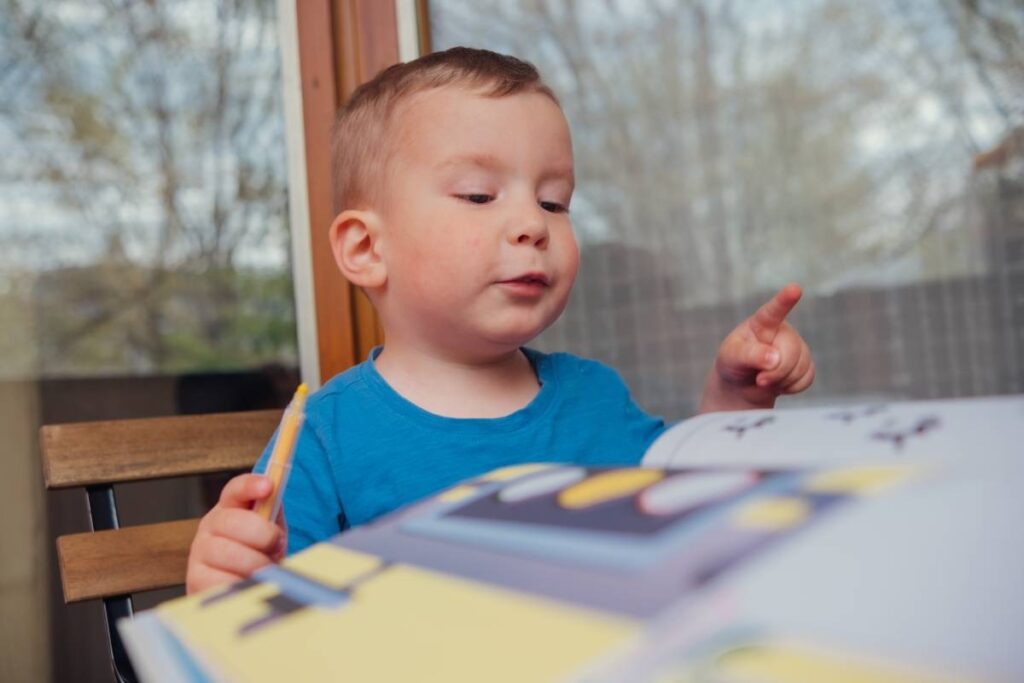
Age five, typically the Foundation or Prep year in Australian schools, is when formal reading instruction begins. Most children make their biggest leaps during this year.
Typical milestones at age 5:
- Blends 3-4 letter words using basic phonics (cat, sit, hop)
- Recognises 20-40 common sight words (the, and, is, a, my)
- Reads very simple books with repetitive text independently
- Understands left-to-right and top-to-bottom reading direction
- Can identify rhyming words reliably
What helps most at this stage: Decodable readers (books that use only phonics patterns already taught), sight word flashcard practice, and letting them “read” to younger siblings or toys to build confidence.
Age 6: Reading Independence Builds
By Year 1, children who are on track begin reading simple texts without adult help. Fluency, reading smoothly rather than word by word, starts to develop here.
Typical milestones at age 6:
- Reads short sentences and simple books independently
- Recognises 100+ sight words automatically
- Self-corrects when a word does not sound right
- Reads aloud with some expression and pacing
- Can answer simple comprehension questions about what was read
What helps most at this stage: Give children books at their level — slightly challenging but not frustrating. The “five-finger rule” works well: if a child cannot read five or more words on a page, the book is too hard.
Age 7: Confident, Fluent Readers
By the end of Year 1 or the start of Year 2, most children read connected text with confidence. The shift from “learning to read” to “reading to learn” begins here.
Typical milestones at age 7:
- Reads aloud smoothly with appropriate expression
- Reads silently for short periods (5-10 minutes)
- Understands what was read and can discuss it
- Reads a range of text types (stories, instructions, simple non-fiction)
- Attempts unfamiliar words using phonics and context together
What helps most at this stage: Introduce chapter books with short chapters, non-fiction books on topics the child loves, and audiobooks alongside print versions.
Quick Reference: Milestones at a Glance
| Age | Key Milestone | What Parents Can Do |
| 3 | Enjoys stories, recognises familiar print | Read aloud daily, play rhyming games |
| 4 | Name letters, connect letters to sounds | Alphabet activities, point out letters everywhere |
| 5 | Blends simple words, reads basic sight words | Decodable readers, flashcards |
| 6 | Reads simple books independently, self-corrects | Level-appropriate books, Five-Finger Rule |
| 7 | Reads fluently, understands varied text types | Chapter books, non-fiction, audiobooks |
When to Seek Support
Consider speaking with your child’s teacher or a speech pathologist if your child:
- Is in Year 1 and still cannot reliably identify letters or their sounds
- Consistently skips words, guesses wildly, or refuses to read
- Shows frustration or anxiety around all reading activities
- Has not progressed in reading level after several months of instruction
Early intervention at ages 5-6 is significantly more effective than waiting until Year 3 or 4. The earlier concerns are raised, the more options families have.
Conclusion
Every child follows their own path through these milestones, but knowing what is typical for each age removes the guesswork from supporting them at home. The progression from print awareness at three through to fluent reading at seven is rarely perfectly linear, and that is completely normal.